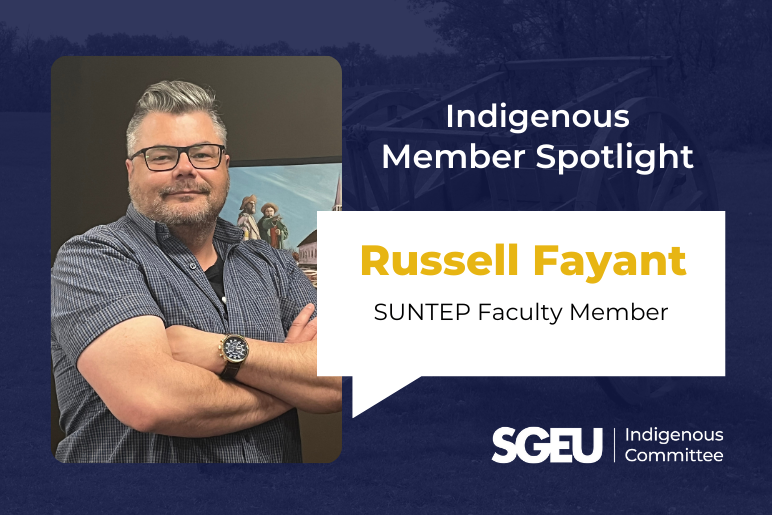
SGEU member Russ Fayant is Métis from southern Saskatchewan. He is an active learner of his language, Michif, and is currently working on a PhD in Indigenous Language Reclamation.
“That’s a big part of my identity,” he noted. “I come from the Qu’Appelle Valley from a road allowance community where my people are from.”
Russ now lives in Regina, where he teaches for a program of the Gabriel Dumont Institute (GDI) called the Saskatchewan Urban Native Teacher Education Program (SUNTEP). Offered in partnership with the University of Regina, SUNTEP is a four-year Bachelor of Education program for Métis students.
Though he has been teaching for 26 years now, Russ admits that it wasn’t always his dream job.
“I come from quite a poor background. I was raised by a single mom who only has a Grade 6 education. I wasn’t raised with this idea of someone telling me I’m going to go to university someday,” Russ explained. “I had dreams of going to university, but I thought, ‘that’s not for poor people.’”
Russ credits his choice of career to encouragement he received as a teenager. “I had great teachers in high school who saw potential in me and told me that I had to go to university,” he recalled. “So, they sort of planted that seed in my head.” He also received advice from an older cousin who graduated from SUNTEP and encouraged him to apply to the program.
“I didn’t have a desire to be a teacher and never dreamed of that growing up . . . but I thought this was one of my only opportunities, so I applied to SUNTEP and ended up falling in love with teaching.”
Union involvement
“. . . I feel that I have played a role in making this a better place to work in and I am quite proud of that.
Russ’s first exposure to union involvement was through his mom, who was a member of CUPE in her position as a housekeeper at Pioneer Village. “I was introduced to the language of the labour movement at an early age,” he explained, recounting how his mom would come home late some days saying that she had attended a union meeting.
He gained further union experience at one of his first workplaces, the Open Door Society. He happened to join the organization as they were going through a decertification vote and got involved with a group of employees who were actively trying to keep the union.
“I remember being mentored by some people there who were very involved in the labour movement,” he explained. “That’s when my union instincts kicked in and I got involved.”
As for SGEU, Russ jokes that he inherited his union involvement from his predecessor at SUNTEP.
“At SUNTEP, I took over for someone who was leaving and was involved. He sort of joked, ‘Well, you’re taking over for me now, so you’ll have to be a steward.’” Since no one else put their name forward, Russ volunteered to take on the role.
Once he was a steward, Russ began taking Learning Development (LD) courses and received mentorship from the chair of his bargaining committee and SGEU Labour Relations Officers.
Eventually, he worked his way up to be on the bargaining committee, where he says he learned the most through hands-on experience: “Most of my learning happened in the actual bargaining process and filing grievances in that process.”
Russ ultimately served as bargaining chair for about 12 years and received certificates in administrative justice, arbitration and mediation. “I just kept learning, kept active and tried to join as many committees as I could.”
When the demands of his union roles became overwhelming on top of his own job, Russ began mentoring the next generation. “And now we have a different bargaining chair, Sheena Yew, who is fantastic,” he remarked.
Looking back, Russ says serving as bargaining chair was a highlight of his union career.
“I had a significant role in shaping at least three of our agreements, and you know, when we’re looking to shape an agreement, we’re looking to solve past problems that keep popping up,” Russ explained. “So, I feel that I have played a role in making this a better place to work in and I am quite proud of that.
“I am also proud of my days on Provincial Council (PC) and Education Sector and just always being an advocate for an Indigenous voice and bringing a different perspective to those meetings in a respectful way.”
The power of listening
"We’re taught in our culture that we’re given two ears and one mouth. So, we should listen twice as often as we speak.”
When it comes to the labour movement, Russ says Indigenous workers bring a lot of strengths to the table.
“I think that Indigenous people are really good at listening,” he said. “I know that we don’t always value that skill within the labour movement because we’re really good at talking and having our voices heard, but I’ve always found that the biggest movements I’ve been able to make in terms of grievances or potential conflicts in the workplace have been by just listening to people.”
“Indigenous people are good at that. We’re taught in our culture that we’re given two ears and one mouth. So, we should listen twice as often as we speak.”
He also said that their values systems are compatible.
“I have always found that my values as a Métis person and Indigenous person align well with community values. It’s about being a community and looking out for each other. I think that’s why our bargaining chairs have been so great. Because they come from a values system that is the same.”
Encouraging involvement
When encouraging people to get involved in the labour movement, Russ says he often frames it in terms of personal development.
“You’re going to get a lot out of it. That’s the advice I give to people. Do it for the right reasons, but also know that you’re going to get a lot out of it in terms of not just benefits, but honing your own skills.”
He also notes that knowing your agreement inside and out makes you more confident in the workplace.
“When I sit at that table, I’m no longer my employer’s employee. I’m their equal. That’s a really powerful thing.”
Advancing reconciliation
“There have been those in the past who want to go into places with a sledgehammer. But that’s not how it works with Indigenous communities. You have to go and build relationships. . . ."
When it comes to reconciliation within the union, Russ says it’s important to open doors for Indigenous members.
“I would say that probably the biggest way that I, as an Indigenous person, has been supported in the union was just mentorship.” He went on to speak highly of the “late, great” Shawna North, a former Education Sector Chair, who he says welcomed him when he was new, asked him to share his opinions, and encouraged him to level up his skills.
“I got to a point where I could look back at where I had come from and say, ‘wow. I’m deeply integrated in this union. I’m not just a steward anymore. I’m someone who knows things and has influence and sits on committees,’” Russ explained.
“That speaks to me—the union making an effort to open to Indigenous people and making an effort to learn.”
Russ also says that it’s important for the union to reach out to non-unionized workplaces and community groups, since many Indigenous workplaces are not unionized.
“There have been those in the past who want to go into places with a sledgehammer. But that’s not how it works with Indigenous communities. You have to go and build relationships. I think we’re starting to understand that as a union and we’re putting people in elected places that understand that.”
Hope for the future
Russ says there are a lot of things that give him hope about the future for Indigenous workers and the labour movement, including the work of the Indigenous Committee and the next generation of Indigenous union activists like GDI Bargaining Chair Sheena Yew.
“I look forward to a much browner union in the future, where Indigenous people have seats at the table,” Russ chuckled. “I remember days at PC when I would look around the room—or even at Convention—and you wouldn’t see any other Indigenous people. But that’s starting to change.”
 View
All Posts
View
All Posts