Think your collective agreement completely protects your job from being contracted out? Think again. A critical review by SGEU’s Anti-Privatization Committee reveals a hidden legal reality: our current contract language protects the process, but fails to protect the outcome.
When it comes to fighting privatization, what we think a contract clause means and what an arbitrator will actually enforce are often two completely different things.
The SGEU Anti-Privatization Committee recently conducted a comprehensive legal audit of our collective agreements. What they found: The issue facing SGEU members is not whether anti-privatization language exists. The issue is whether that language actually changes the outcome.
Most SGEU collective agreements rely heavily on what is known as Process Protection. This gives the union the right to be notified, consulted or invited to “explore alternatives” before privatization happens. But here is the catch: once that meeting is over and the process is complete, the employer is legally free to proceed with contracting out.
To win a grievance at arbitration, the union needs Outcome Protection – hard, explicit injunctions that outright ban contracting out if it results in job losses.
Canadian labour law is clear and has been consistent since the 1970s. The governing legal principle states:
“A restriction on contracting out requires an explicit prohibition in the collective agreement. In the absence of such explicit language, the employer retains the management right to contract out work.”
- Canadian Arbitration Jurisprudence (2024 CanLII 38826)
To understand how vulnerable we are, look at how different types of contract language perform when an employer decides to privatize:
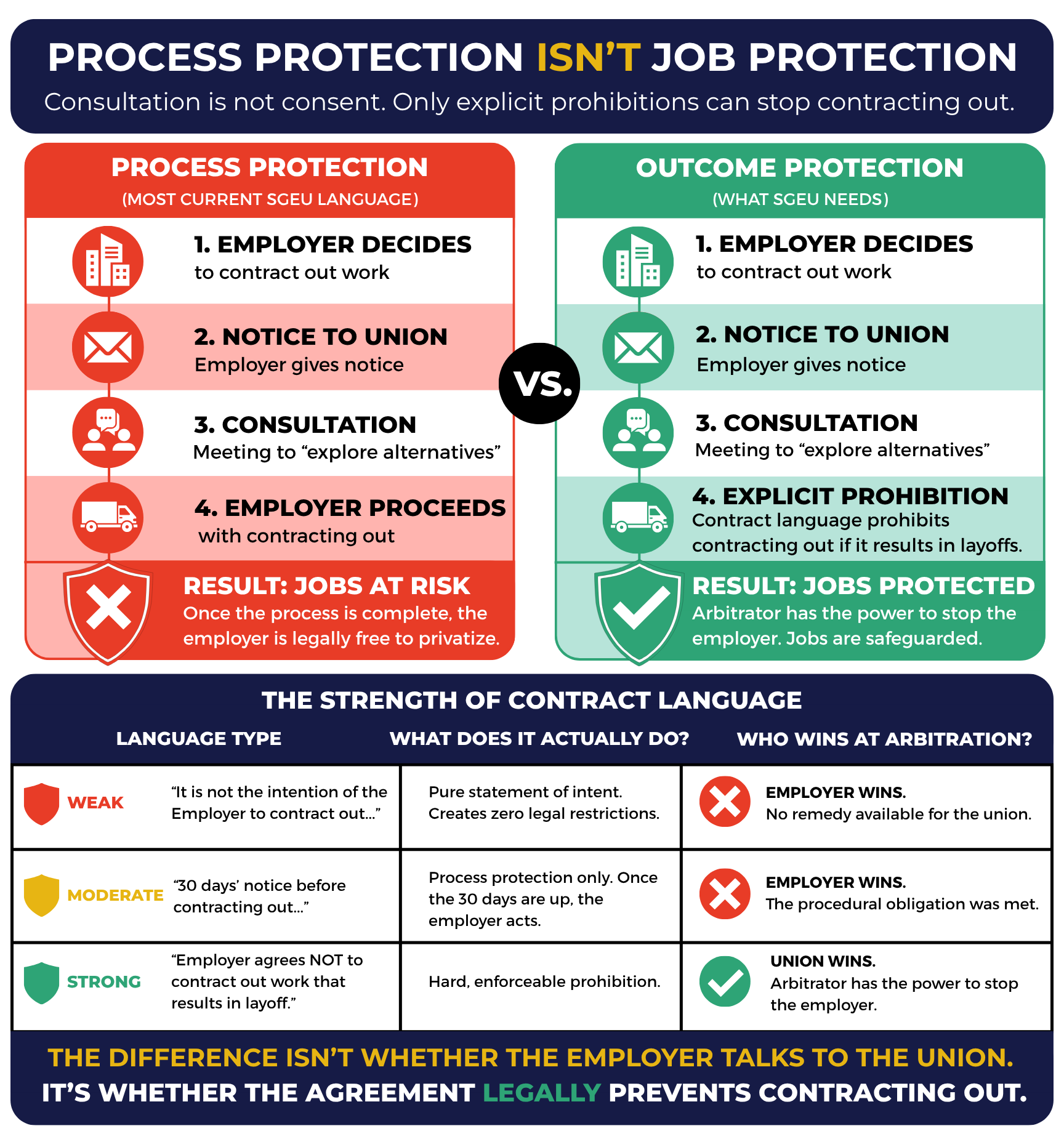
The most common language found across SGEU contracts is the “intention” statement. Legally speaking, this provides no enforceable protection. In fact, at least one current SGEU agreement (Saskatoon Open Door Society) explicitly states the employer “will not be restricted from practices of contracting out.” This type of language actively works against us.
The warning from recent court cases
This isn’t theoretical. Between 2022 and 2024, multiple Canadian unions lost major contracting-out grievances for these exact reasons:
- The No-Prohibition Trap (2024): An Alberta refinery contracted out standard union positions. The union sued, but because the agreement only had conditional language and no explicit prohibition, the arbitrator ruled the employer was within its management rights.
- The Consultation Trap (2022-2024): In multiple cases across BC, Alberta and Ontario, arbitrators ruled that “a right to consult is not a right to consent.” Once the employer held a meeting with the union, they were allowed to privatize the work anyway.
What does this mean for SGEU?
Right now, our defenses are down. If we want to safeguard public services and keep our crowns, healthcare, education, and community jobs in Saskatchewan, we have to change how we bargain. We must move past asking for good “intentions” and start demanding hard prohibitions.
 View
All Posts
View
All Posts